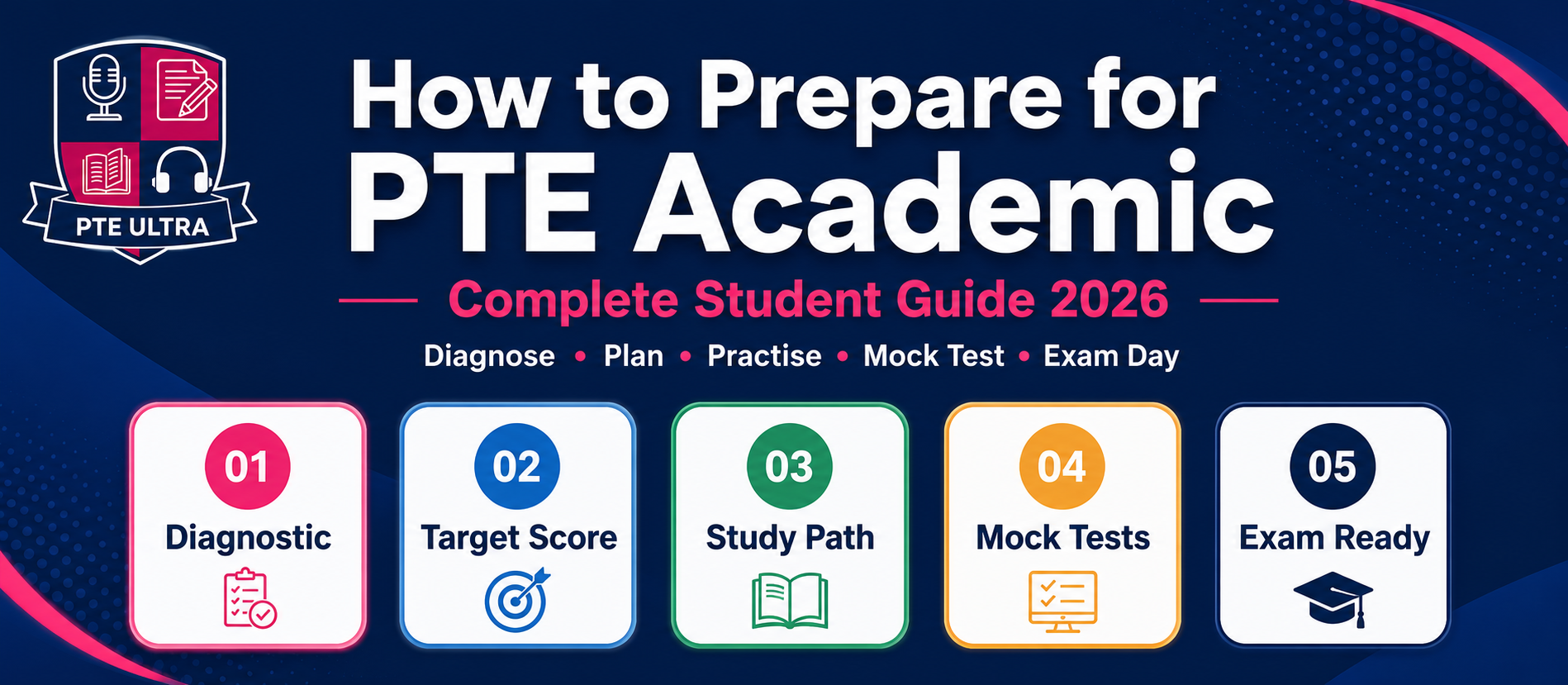
How to Prepare for PTE Academic in 2026 | PTE Ultra
Learn how to prepare for PTE Academic in 2026 with a practical study plan, diagnostic test, score targets, weekly timeline, exam checklist, and common mistakes to avoid.
PTEUltra.com
PTE Preparation Guide - 2026 Updated
How to Prepare for PTE Academic in 2026
A complete student guide to choosing your test date, evaluating your English level, building a study plan, avoiding common mistakes, and entering exam day with confidence.
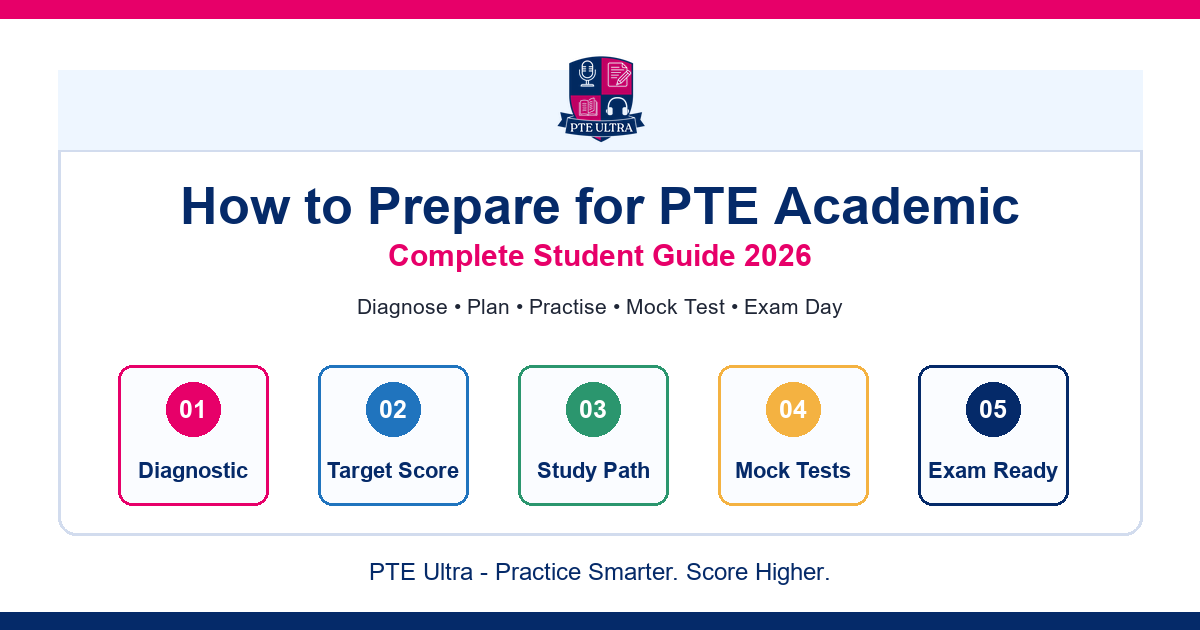
How to Prepare for PTE Academic in 2026
Whether you have two weeks or three months, the way you prepare for PTE Academic in 2026 matters more than ever. With hybrid scoring, newer task types, and stronger content evaluation now in place, blind memorisation is outdated. Smart, structured preparation is everything.
This guide walks you through every step, from choosing your current level to building your study plan and knowing when you are ready to book.
Step 1: Before You Do Anything Else
Effective preparation starts with five things. Skip any one of them and you may waste study time on the wrong areas.
Deciding When to Take the Test
Before you book your PTE exam, identify three things clearly. Getting this wrong can rush your preparation or waste your application deadline.
| Identify Before Booking | Why It Matters |
|---|---|
| Exact score requirement | Your institution, visa body, or professional authority may require a specific overall score and skill scores. |
| Minimum target score | Your target may be 50, 65, 79, or 90 depending on your goal. |
| Application deadline | Work backwards from your deadline and allow time for practice, results, and possible retakes. |
Evaluate Your English Proficiency First
Before building a study plan, you need to know your starting point. Weakness in one area can pull down your overall score even if your other skills are strong.
- Identifying the writer's attitude or viewpoint
- Thinking critically about information
- Distinguishing main ideas from details
- Working out the meaning of unfamiliar vocabulary
- Understanding multi-speaker conversations
- Identifying key arguments in audio
- Accurate note-taking from a single hearing
- Recognising context and speaker purpose
- Spelling every word correctly
- Addressing the topic clearly and fully
- Linking points and ideas coherently
- Using a varied vocabulary and sentence structure
- Pronouncing English sounds accurately
- Speaking fluently without hesitating or pausing too often
- Using your voice to stress key points naturally
- Paraphrasing ideas instead of repeating memorised lines
Choose Your Preparation Path
Your preparation style depends on how much time you have and your current English level. Be honest with yourself. Choosing the wrong path wastes time you may not have.
Best for students with 2-4 weeks who already have decent English and need score-focused practice.
- Complete a scored practice test first.
- Use worksheets and common mistake videos.
- Divide time between target skills.
- Take a second practice test before exam day.
Best for students with 6-12 weeks who need a stronger foundation and full skill improvement.
- Count how many weeks you have.
- Complete the official or platform readiness checklist.
- Use a structured learning path.
- Take multiple mock tests under real conditions.
Use AI feedback, mock tests, smart templates, and progress tracking to prepare with less guesswork.
Start Free PracticeYour Week-by-Week Study Timeline
| Week | Focus |
|---|---|
| Week 1 | Take a full diagnostic mock test. Identify weakest modules and set your score target. |
| Week 2 | Learn every task type. Understand scoring criteria for each module and begin high-value tasks such as Read Aloud and Repeat Sentence. |
| Week 3 | Deep dive into weakest modules. Practise priority tasks such as Reading & Writing Fill in the Blanks, Describe Image, Summarise Group Discussion, and Write From Dictation. |
| Week 4 | Full section practice under timed conditions. Start writing essays or emails without overusing templates. |
| Week 5 | Complete two full mock tests under real exam conditions and analyse the score report carefully. |
| Final week | Light revision only. Review templates, practise personal introduction, check audio setup, and avoid learning new strategies at the last minute. |
Know Your Score Target
Your preparation intensity should match your score target. High scores require sharper accuracy and stronger habits.
- Build grammar and vocabulary.
- Master high-weight task basics.
- Use structured templates carefully.
- Practise dictation and repeat sentence daily.
- Strong content development.
- Reduce template dependency.
- Fix weak modules one day at a time.
- Maintain fluency without rushing.
- Near-perfect grammar and content.
- Complex sentence structures in writing.
- Natural intonation and fluency.
- High accuracy in Write From Dictation.
Pre-Exam Preparation Checklist
- Completed at least two full mock tests under real timed conditions.
- Reviewed score reports and identified no remaining critical weak areas.
- Practised all 22 priority PTE preparation tasks in your study plan at least once.
- Scoring consistently above your target score in mock tests.
- Practised Write From Dictation daily for at least two weeks.
- Easy responses address the prompt fully and are grammatically accurate.
- Practised Summarise Group Discussion with multiple speakers.
Exam Day Logistics
- Valid passport or accepted ID confirmed.
- Test centre location confirmed and travel time planned.
- Arrive at least 30 minutes early.
- Personal introduction practised for confidence.
- Good sleep the night before.
Mistakes That Derail Preparation
Your PTE Success Starts With the Right Preparation
PTE Academic preparation in 2026 should be focused, structured, and score-driven. Start with a diagnostic test, build a realistic study plan, practise high-impact tasks, and use feedback to improve each week.