PTE Exam Format 2026: Structure, Timing and Task Types | PTE Ultra
Understand the latest PTE Academic and PTE Core exam format, section timings, question types, scoring insights, and how to prepare smarter with PTE Ultra.
PTEUltra.com
PTE Ultra 2026 Guide
PTE Exam Format 2026: Structure, Timing and Task Types
If you are planning to take PTE Academic or PTE Core, understanding the official exam structure is the first step to preparing smarter and scoring higher.
PTE Exam Format 2026: Structure, Timing and Task Types
If you are planning to take PTE Academic or PTE Core, understanding the exact structure is the first step to scoring high.
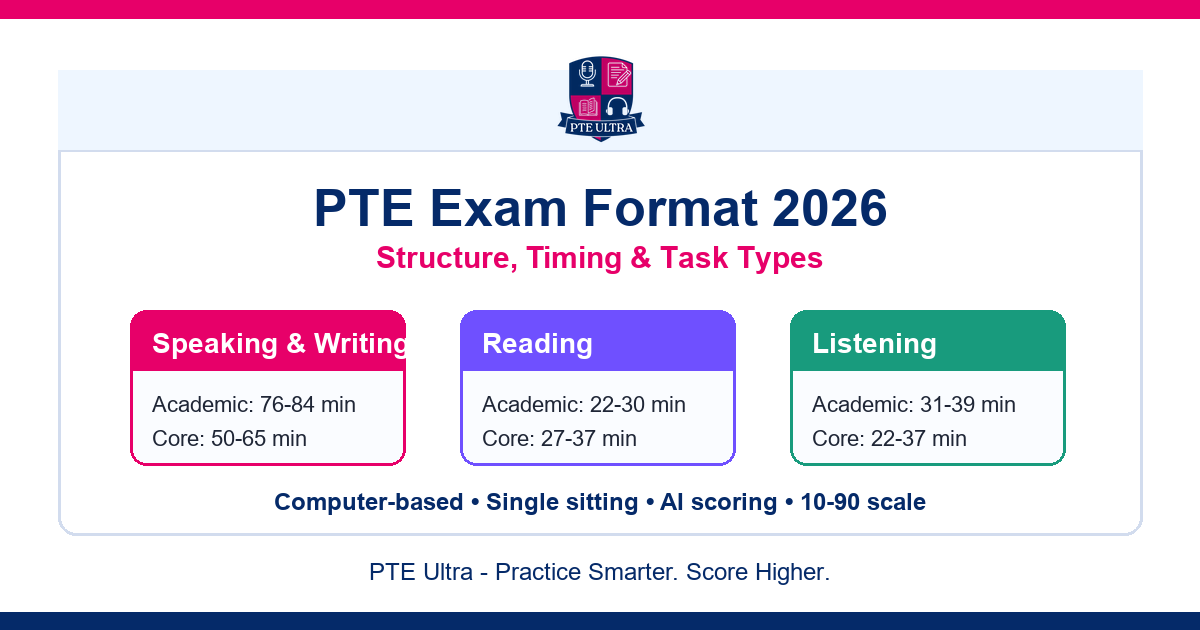
Both exams are fully computer-based and completed in a single sitting. There is no human examiner in the speaking test. Your responses are scored using Pearson's automated scoring system, which is designed to deliver fast and consistent results.
Overview of the PTE Exam Structure
The PTE test is divided into three main parts:
The exact timing is not the same for PTE Academic and PTE Core, so it is important to prepare with the correct version of the test.
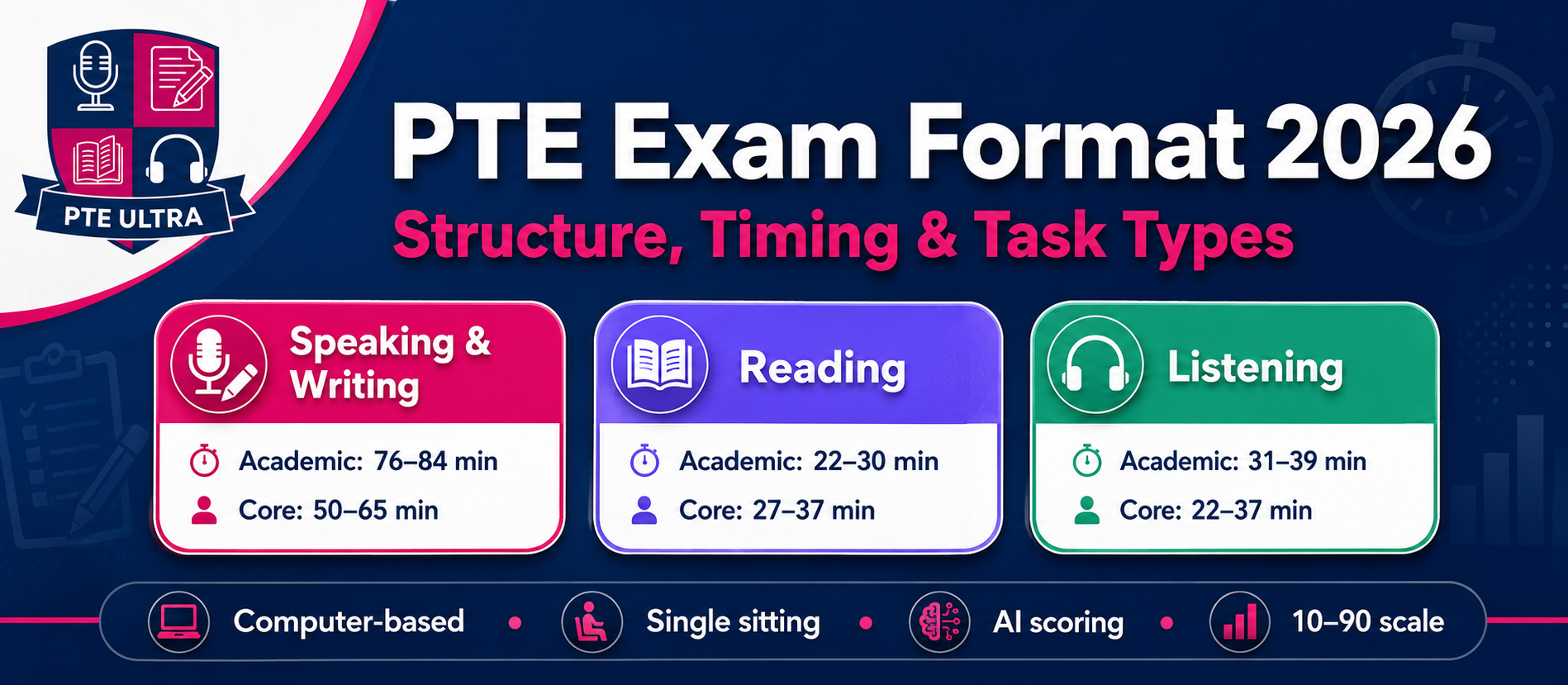
Total Timing Summary
| Section | PTE Academic | PTE Core |
|---|---|---|
| Speaking & Writing | 76-84 minutes | 50-65 minutes |
| Reading | 22-30 minutes | 27-37 minutes |
| Listening | 31-39 minutes | 22-37 minutes |
| Total | Approximately 2 hours | Approximately 2 hours |
Part 1: Speaking & Writing
This is the longest section of the test and combines speaking, pronunciation, fluency, grammar, vocabulary, and written communication skills.
| Task | What It Tests | Smart Preparation Tip |
|---|---|---|
| Personal Introduction | Not scored. Used for identification or institution reference. | Speak clearly, but do not spend preparation time treating this like a scoring task. |
| Read Aloud | Pronunciation, oral fluency, and reading accuracy. | Maintain a natural pace and avoid unnecessary pauses. |
| Repeat Sentence | Listening, memory, pronunciation, and fluency. | Focus on meaning, keywords, and sentence rhythm. |
| Describe Image | Speaking fluency and ability to describe visual information. | Use a simple structure: introduction, key points, and summary. |
| Retell Lecture | Listening and speaking together. | Note keywords while listening and speak in a clear summary format. |
| Answer Short Question | Listening comprehension and short spoken response. | Give a short, direct answer. Do not over-explain. |
| Summarize Written Text | Reading and writing accuracy. | Write one clear sentence that captures the main idea. |
| Write Essay / Write Email | PTE Academic uses essay writing; PTE Core uses practical email writing. | Use a clear structure. Organisation matters more than difficult vocabulary. |
New and Practical Task Types to Know
Recent Pearson test formats include more practical communication tasks across PTE Academic and PTE Core. These tasks reflect how English is used in study, work, and everyday situations.
| Task | Where It Appears | What It Measures |
|---|---|---|
| Respond to a Situation | PTE Core speaking and writing format | Practical spoken response in a real-life situation. |
| Summarize Group Discussion | PTE Academic speaking and writing format | Ability to understand and summarise multiple speakers. |
| Write Email | PTE Core writing format | Clear workplace or everyday written communication. |
Part 2: Reading
The Reading section evaluates your ability to understand written English, grammar, vocabulary, logical order, and meaning.
| Task | What It Tests | Preparation Tip |
|---|---|---|
| Reading & Writing: Fill in the Blanks | Grammar, vocabulary, and sentence meaning. | Focus on collocations, word forms, and grammar clues. |
| Multiple Choice | Understanding the main idea and details of a passage. | For multiple-answer questions, avoid selecting answers unless you are confident. |
| Re-order Paragraphs | Logical sequencing and text structure. | Look for pronouns, connectors, chronology, and repeated ideas. |
| Fill in the Blanks | Vocabulary and contextual understanding. | Read before and after the blank before selecting the word. |
Part 3: Listening
The Listening section tests your ability to understand spoken English in different accents and respond accurately under time pressure.
| Task | What It Tests | Preparation Tip |
|---|---|---|
| Summarize Spoken Text | Listening comprehension and written summary skills. | Capture the topic, key points, and conclusion. |
| Multiple Choice | Understanding details and overall meaning from audio. | Read the question before the audio starts. |
| Fill in the Blanks | Listening accuracy and spelling. | Type carefully and check grammar after the audio ends. |
| Highlight Correct Summary | Identifying the best summary of the audio. | Focus on the central message, not only matching words. |
| Select Missing Word | Predicting meaning from context. | Listen for the direction of the final idea. |
| Highlight Incorrect Words | Listening and reading comparison. | Follow the transcript closely without losing audio pace. |
| Write From Dictation | Listening, memory, spelling, and grammar. | Practise daily. This is one of the most important high-impact tasks. |
Key Scoring Insights
- Describe Image, Repeat Sentence, Summarize Group Discussion, Summarize Written Text, Essay or Email Writing, Summarize Spoken Text, and Write From Dictation are smart high-impact practice priorities.
- Repeat Sentence and Write From Dictation are especially important because they can influence more than one skill area.
- Speaking performance can affect your speaking score and may also contribute to listening-related scoring depending on the task.
- Self Introduction is not scored, so do not treat it as a priority scoring task.
- Essay or email writing still matters, but structure and clarity are more important than using difficult vocabulary.
How to Crack PTE Faster
Most students struggle because they focus too much on theory, ignore high-weight tasks, and do not practise with scoring-style feedback.
At PTE Ultra, preparation is designed around real exam-style practice, AI feedback, smart templates, and high-scoring task mastery.
Start Your Preparation with PTE Ultra
If your goal is to score faster with a focused plan, start with the task types that matter most. Practise speaking, writing, reading, and listening using a system that helps you understand exactly where you are losing marks.