What is PTE? Complete Beginner's Guide 2026 | PTE Ultra
New to PTE? This complete beginner
PTEUltra.com
PTE Ultra Beginner Guide
What is PTE? A Complete Beginner's Guide (Academic & Core)
New to PTE? This complete beginner's guide explains what PTE is, the difference between PTE Academic and PTE Core, exam format, scores, and how to start preparing today.
Introduction
If you're planning to study, work, or migrate to Australia or New Zealand, chances are you've heard the term PTE. But what exactly is PTE, and why is it the English test of choice for thousands of migrants every year?
In this complete beginner's guide, PTE Ultra walks you through everything you need to know - from what PTE stands for, to how the exam works, what scores you need, and how to start preparing. Whether you're sitting the exam for the first time or just exploring your options, this guide has you covered.
If you're just starting out, platforms like PTE Ultra can help you understand your current level with AI-based scoring and real exam-style practice from day one.
What Does PTE Stand For?
PTE stands for Pearson Test of English. It is an internationally recognised English language proficiency test developed and administered by Pearson, one of the world's largest education companies.
PTE is designed to assess how well you can read, write, speak, and listen in English. It is accepted by universities, governments, and professional organisations worldwide, including pathways for Australia and New Zealand where PTE Academic is accepted.
Defining PTE Academic
PTE Academic is a leading computer-based English language proficiency exam. It is designed to assess the real-life communication skills of non-native English speakers in an academic or professional context.
Unlike traditional exams, PTE Academic is computer-based. From booking to testing and score delivery, the process is designed to be fast, consistent, and technology-led.
The AI Advantage: Why it Matters
What sets PTE apart is its automated scoring system. Because technology evaluates your performance, results are designed to be consistent and fast.
- Fair and consistent: Your score is based on your test performance.
- Fast results: Pearson says results are typically available in about two days.
- Clear score scale: PTE scores are reported on the 10-90 scale.
Global Recognition
Whether you are applying for a Student Visa in Australia or pursuing higher education in the UK, New Zealand, Canada, or other destinations, PTE Academic is widely used for study, work, and migration pathways. Pearson states that PTE Academic is accepted by thousands of universities and approved for Australia and New Zealand visa pathways.
PTE Academic vs PTE Core: What's the Difference?
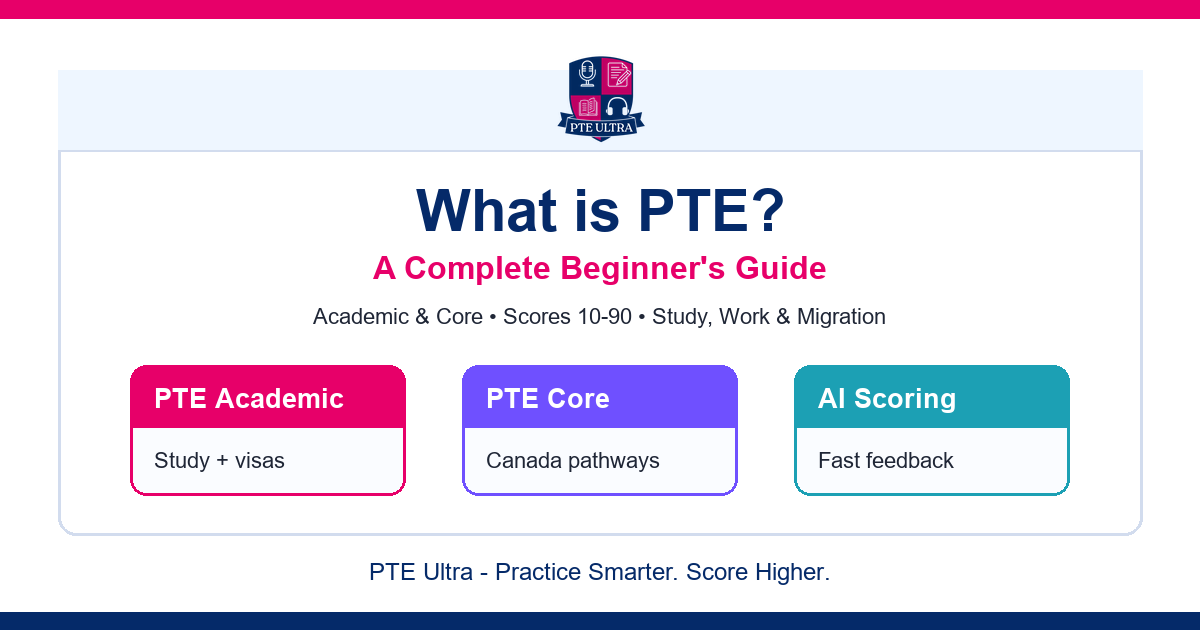
PTE Academic and PTE Core are both computer-based English tests from Pearson, but they are used for different goals. Choosing the right one depends on why you need an English score.
| Feature | PTE Academic | PTE Core |
|---|---|---|
| Main purpose | Study abroad, university admission, professional registration, and Australia/New Zealand visa pathways. | General English ability for Canadian IRCC permanent residency and citizenship pathways. |
| Language focus | Academic and real-life communication in study or professional settings. | Everyday English used in workplace and general life situations. |
| Test delivery | Computer-based with automated scoring. | Computer-based with automated scoring. |
| Best for | Students, skilled migrants, and applicants who need an academic English test. | Applicants who need a general English test for accepted Canadian immigration purposes. |
If you are applying to a university, PTE Academic is usually the test you will see listed. If you are applying for migration or work, check the exact English test accepted for your visa or program before choosing between PTE Academic and PTE Core.
PTE Exam Format: What Skills Are Tested?
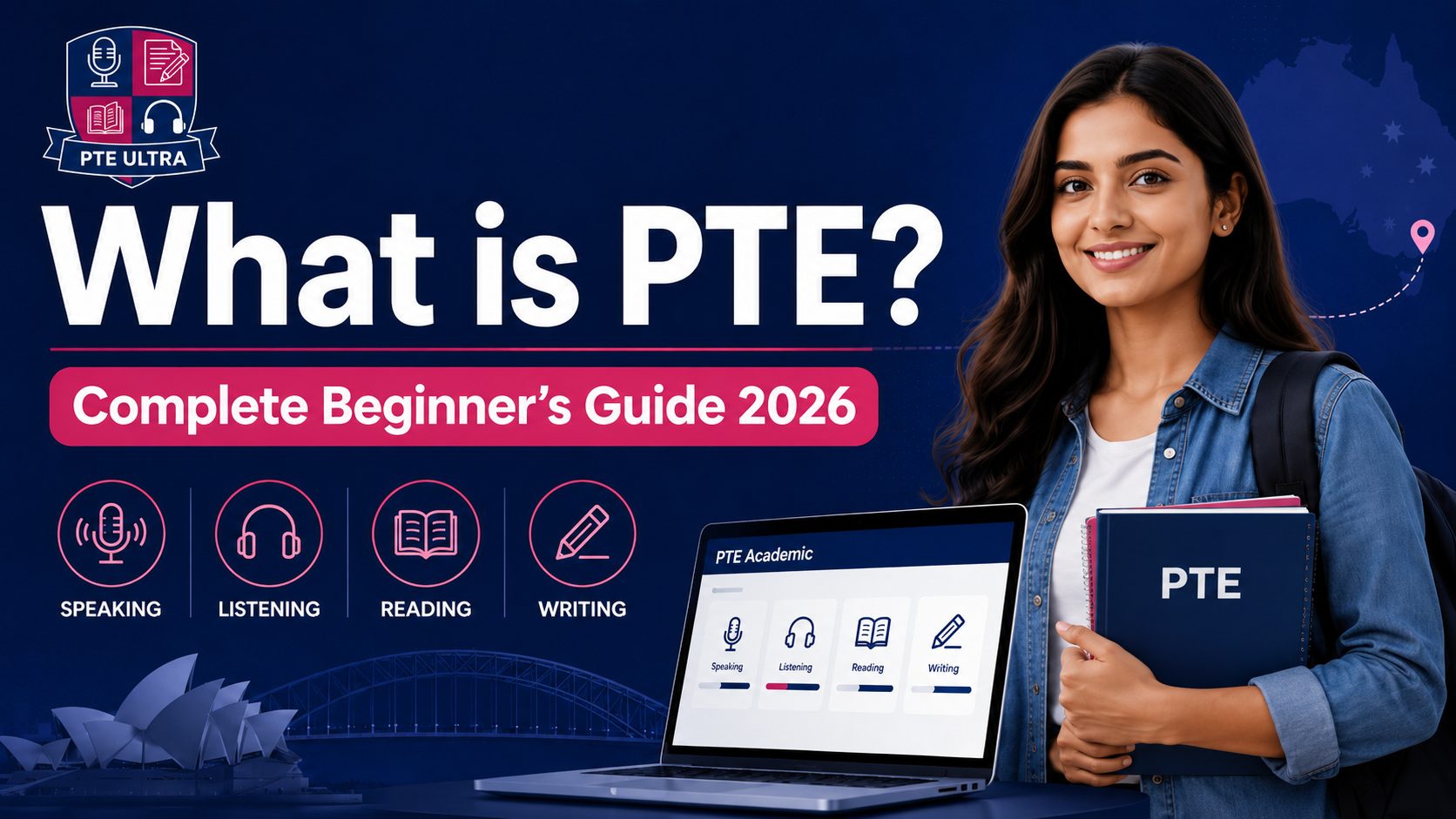
PTE assesses the four key English skills: speaking, writing, reading, and listening. Some question types test more than one skill at the same time. For example, a speaking task may also measure pronunciation and oral fluency, while a writing task may check grammar, vocabulary, spelling, and structure.
- Speaking: Read aloud, repeat sentence, describe image, retell lecture, and short spoken responses.
- Writing: Summarise written text, essay-style responses, or email-style responses depending on the test.
- Reading: Multiple choice, reorder paragraphs, and fill-in-the-blank tasks.
- Listening: Summaries, dictation, multiple choice, and fill-in-the-blank tasks based on audio.
Understanding PTE Scores
PTE Academic and PTE Core overall scores are reported on Pearson's 10-90 scale. Your overall score reflects your combined performance, while your communicative skill scores show how you performed in speaking, writing, reading, and listening.
How to Start Preparing for PTE
The best way to begin is to understand the format, take a diagnostic practice test, and identify your weakest areas. Many beginners waste time practising randomly. A smarter approach is to practise with exam-style questions and review your performance after every attempt.
- Practise speaking aloud every day to improve fluency and confidence.
- Use templates carefully, but do not depend on memorised answers alone.
- Track your spelling, grammar, and pronunciation mistakes.
- Repeat difficult question types until your timing becomes natural.
- Use AI-based feedback from PTE Ultra to measure progress before booking the real exam.
Final Thoughts
PTE is more than just an English test. For many students and migrants, it is a key step toward study, work, permanent residency, or a new life overseas. The good news is that PTE is highly learnable when you understand the format and practise with a clear strategy.
Start simple: learn the test, know your target score, practise with real exam-style tasks, and use feedback to improve one skill at a time.